
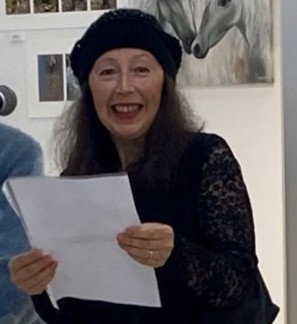
Milanka Djuranovic Bajcetic (born in Titograd, Yugoslavia, now Podgorica, Montenegro), is an autodidactic and independent artist based in Podgorica. She has been exhibiting since 2002. She has made design and illsutrations for several books and writes poetry. For many years she was a member of the Izvorni likovni umjetnci Crne Gore (Original Fine Artists of Montenegro) and a member of the NGO “Slikarski Uranak” from Podgorica. She is the founder of NGO “Likovni etnos Crne Gore” (Art Ethnos of Montenegro).
On her self-taught artistic journey, she found inspiration in Professor Dobroslav Mrdak, her former Art History professor, while Ms. Tinda Bulatović, a graduate of the Academy of Applied Arts in Belgrade, introduced her to the pastel technique. At the suggestion of Ms. Bulatović, Milanka began leading an art workshop „Workshop school of drawing and painting – Treće Doba”, which she has now been running successfully for eight years.
Her work has been the subject of analysis and writing by numerous Montenegrin art historians, including Professor Lazar Seferović, Draginja Kujović, Petrica Duletić, Dr Aleksandar Čilikov, MA Ljiljana Karadžić, as well as MA in Painting Nikica Raičević, MA in Sculpture Velibor Pavićević, Dr Lidija Vujačić…
Her artistic forms represent a lyrical way of visual expression, using specific colorful circles that she applies with a brush. In her view, circles and arcs have the perfect shape and reflect cosmic energy and unity.
Her creative collages in the ancient encaustic technique, created with flower petals on a hard surface, are reminiscent of oil on canvas paintings.
Through research, she explore sources, observing the microcosm and macrocosm within and around her, as well as the relationships between the spiritual and the material, the visible and the invisible, cause and effect, which dominates in her artistic work.
She believes that art has the power to influence reality and can help create a better future.
She does not distance herself from the aspirations, fears, and dreams that make up our daily lives. She strives to connect with her inner self and wants to portray essential truths that transcend the boundaries of time.
Thematically so far, her focus is on environmental protection, botany, natural phenomena, as well as the relationship between masculine and feminine energy. She is also interested in cultural and historical heritage and ethnic women’s costumes, as well as museum treasures, archaeological sites, and urban structure, along with experiences from her hometown.
The rich diversity of her country and respect for it, capture her attention.
By seeking what is, and not what is not, she hopes that we will carry the legacy of civilization’s culture and art with dignity and that, with their help, we will overcome problems.
In her experimental work, her abstract paintings with minimalist elements, convey the philosophical message that “less is more,” where order and chaos coexist. Her works are subtle yet feature strong colors, and the lyrical composition of colored circles creates vortices and powerful vibrations, making her works special and original. Viewers at her exhibitions share a sense of joy, creating a shared experience of art.
Milanka Djuranovic Bajcetic (born in Titograd, Yugoslavia, now Podgorica, Montenegro), is an autodidactic and independent artist based in Podgorica. She has been exhibiting since 2002. She has made design and illsutrations for several books and writes poetry. For many years she was a member of the Izvorni likovni umjetnci Crne Gore (Original Fine Artists of Montenegro) and a member of the NGO “Slikarski Uranak” from Podgorica. She is the founder of NGO “Likovni etnos Crne Gore” (Art Ethnos of Montenegro).
On her self-taught artistic journey, she found inspiration in Professor Dobroslav Mrdak, her former Art History professor, while Ms. Tinda Bulatović, a graduate of the Academy of Applied Arts in Belgrade, introduced her to the pastel technique. At the suggestion of Ms. Bulatović, Milanka began leading an art workshop „Workshop school of drawing and painting – Treće Doba”, which she has now been running successfully for eight years.
Her work has been the subject of analysis and writing by numerous Montenegrin art historians, including Professor Lazar Seferović, Draginja Kujović, Petrica Duletić, Dr Aleksandar Čilikov, MA Ljiljana Karadžić, as well as MA in Painting Nikica Raičević, MA in Sculpture Velibor Pavićević, Dr Lidija Vujačić…
Her artistic forms represent a lyrical way of visual expression, using specific colorful circles that she applies with a brush. In her view, circles and arcs have the perfect shape and reflect cosmic energy and unity.
Her creative collages in the ancient encaustic technique, created with flower petals on a hard surface, are reminiscent of oil on canvas paintings.
Through research, she explore sources, observing the microcosm and macrocosm within and around her, as well as the relationships between the spiritual and the material, the visible and the invisible, cause and effect, which dominates in her artistic work.
She believes that art has the power to influence reality and can help create a better future.
She does not distance herself from the aspirations, fears, and dreams that make up our daily lives. She strives to connect with her inner self and wants to portray essential truths that transcend the boundaries of time.
Thematically so far, her focus is on environmental protection, botany, natural phenomena, as well as the relationship between masculine and feminine energy. She is also interested in cultural and historical heritage and ethnic women’s costumes, as well as museum treasures, archaeological sites, and urban structure, along with experiences from her hometown.
The rich diversity of her country and respect for it, capture her attention.
By seeking what is, and not what is not, she hopes that we will carry the legacy of civilization’s culture and art with dignity and that, with their help, we will overcome problems.
In her experimental work, her abstract paintings with minimalist elements, convey the philosophical message that “less is more,” where order and chaos coexist. Her works are subtle yet feature strong colors, and the lyrical composition of colored circles creates vortices and powerful vibrations, making her works special and original. Viewers at her exhibitions share a sense of joy, creating a shared experience of art.